Chinook Salmon: The Trophy of Lake Michigan
Chinook (king) salmon are the flagship species of Lake Michigan's sport fishery. These fish can grow to 20, 30, or occasionally even larger pounds — and catching one on appropriate tackle is a physical and memorable experience. Chinook are primarily targeted via downrigger trolling, which allows presentation of lures at precise depths where fish are holding.
Near Chicago, chinook fishing is most productive in late spring (May–June) and again in the fall run (September–October). Summer months see fish move to deeper, cooler water — captains must extend their downriggers deeper to reach the thermocline where fish are comfortable. Early morning is typically the most productive time on Lake Michigan regardless of season.
Chinook in Lake Michigan are planted fish managed by state fisheries agencies — the fishery is sustained by stocking programs. The biologically and ecologically robust lake ecosystem makes these fish grow well and fight hard. The stocking program also introduces predictability: fish show up at expected times in expected areas, which is why experienced captains catch fish consistently.
Coho Salmon: More Accessible, Always Exciting
Coho salmon are smaller than chinook but more numerous and often available at shallower depths — making them accessible earlier in the season and catchable with a wider range of techniques. A coho of 6–10 pounds is a fine catch and a strong fighter. They're also excellent on the table.
Near Chicago, coho fishing is productive from late April through early summer. Fish are often within the first 20–40 feet of water in May and early June before warmer surface temperatures push them deeper or further offshore.
Coho are the beginner-friendly salmon species — they're more willing to bite a wider variety of lures and presentations, which gives newer anglers more action. A half-day coho charter in May can produce multiple hook-ups per angler, which is a great introduction to Lake Michigan salmon fishing.
Salmon Fishing Techniques on Lake Michigan
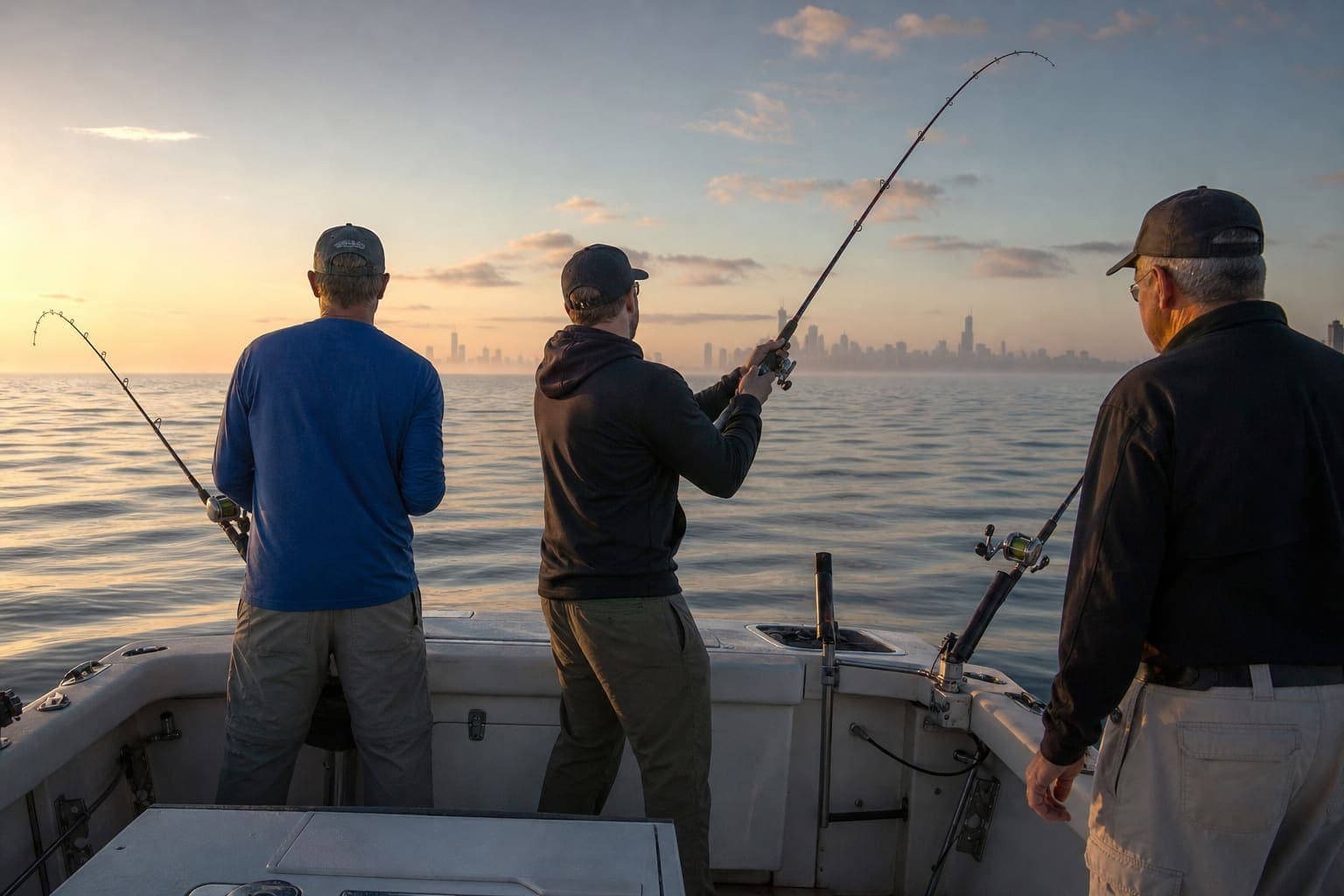
Downrigger trolling is the primary technique for reaching salmon at depth. A downrigger uses a weighted ball on a cable to take lures to a precise depth — critical when fish are holding at specific temperature layers. Your charter captain manages the downriggers while you hold the rod and wait for the strike.
Spoon, plug, and fly lures each have seasonal applications. Bright spoons work well in spring when water visibility is lower; natural-color plugs often perform better in summer when the water clears. Your captain's lure selection is part of the expertise you're paying for.
Planer boards extend the trolling spread, allowing multiple lines to run at different angles from the boat without tangling. A properly rigged board spread with downriggers puts lures at multiple depths and angles simultaneously — maximizing the water column covered on each pass.
The Stocking Program That Sustains Lake Michigan's Salmon Fishery
Lake Michigan's salmon fishery is sustained by an active stocking program coordinated by the Great Lakes Fishery Commission and the individual state fishery agencies of Illinois, Indiana, Michigan, and Wisconsin. Chinook and coho salmon, along with lake trout and brown trout, are raised in state hatcheries and released into the lake system at specific locations calibrated to support the sport fishery without overstressing the forage base.
Illinois's stocking program, managed by the Illinois Department of Natural Resources, focuses primarily on the Illinois nearshore zone. Stocking locations near Chicago — including the Calumet area and other tributaries — are designed to imprint salmon on the Illinois shoreline so that they return to accessible nearshore areas when they mature. This homing behavior is why the fall salmon run brings fish predictably back to Chicago-area waters each September and October.
The alewife population — the primary forage base for Lake Michigan's stocked salmon — has fluctuated significantly over recent decades, and fishery managers adjust stocking rates in response to alewife abundance. In years when alewife populations are lower, salmon stocking is reduced to prevent the predator population from outstripping the food supply. This biological calibration is ongoing and is part of why keeping current with IDNR fishery reports gives anglers a better sense of what to expect in any given season.
Charter Tackle and How to Read What the Captain Is Doing
Understanding the basic setup on a Lake Michigan salmon charter helps guests participate more meaningfully in the experience. Downrigger cables extend down from the boat's gunwales, suspending cannonball weights that carry lures to the specified depth. The lure is attached to the downrigger cable via a release clip — when a fish strikes, the clip releases and the angler fights the fish on free line. The captain adjusts downrigger depth throughout the day based on sonar readings of water temperature and fish position.
Planer boards run from line releases at the bow, extending lures out to the sides of the boat's wake rather than directly behind. This spreads the trolling pattern, covering more water column and reducing the chance that boat noise spooks fish before they encounter the lure. A properly rigged spread with downriggers and boards covers multiple depths and angles simultaneously — maximizing the lake's productive zones on each trolling pass.
When a rod goes down with a strike, the captain will call which rod is hit and guide you to grab it. Keep tension on the line, don't give slack, and let the rod work. Salmon make powerful initial runs — the combination of a heavy fish and fast open-water movement can strip significant line from a reel before the fish settles into a fight. Follow the captain's coaching rather than improvising, especially for first-time salmon anglers who are experiencing this kind of fight for the first time.