What Fish Live in Lake Michigan Near Chicago?
Chinook (king) salmon are the trophy species on Lake Michigan. These fish can exceed 20 pounds and put up a serious fight on appropriate tackle. Chinook are most available in late spring and early fall when water temperatures drive feeding behavior close to the surface.
Coho salmon are smaller and more numerous than chinook, and are accessible much of the open-water season. Coho fishing near Chicago can be excellent from late April through mid-summer.
Lake trout inhabit deeper, colder water and require deep-trolling techniques. They're a year-round species in suitable temperatures and can grow to impressive sizes in Lake Michigan's cold, clear water.
Steelhead (rainbow trout) enter Chicago-area waters primarily in spring and fall. These fish are acrobatic fighters and are prized by sport anglers. Spring steelhead run timing varies year to year based on water temperature.
Yellow perch are the most accessible species for casual and family anglers. Perch are found in nearshore areas, harbor waters, and along breakwaters — you don't need a charter to target perch. They're excellent table fare and are a family fishing staple on Lake Michigan.
Fishing Charter vs Pier Fishing in Chicago
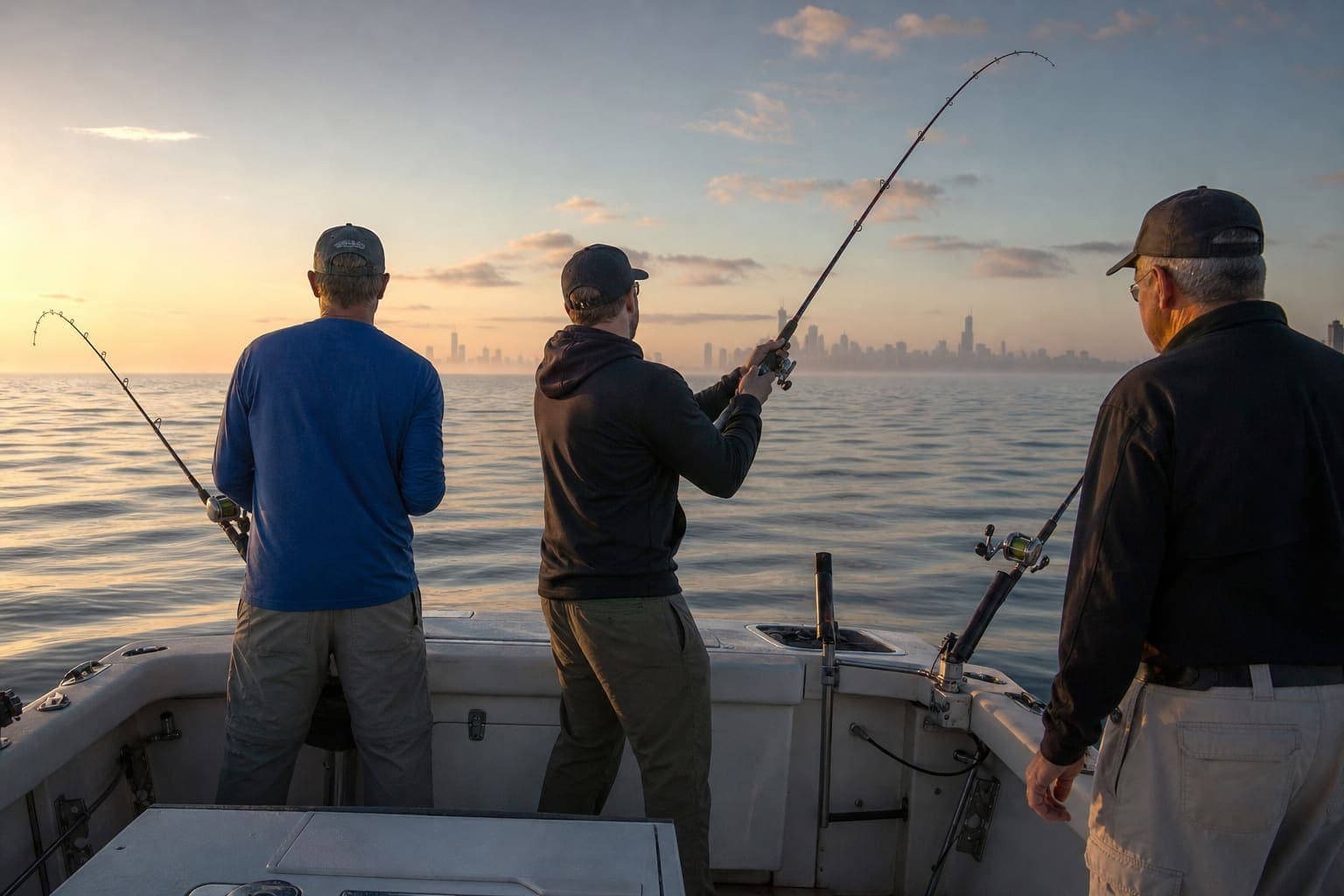
Fishing charters are the most effective way to target salmon and lake trout in Lake Michigan. Experienced captains know where the fish are, have the appropriate trolling gear, and manage the lines for you. Charter fishing is recommended for anglers specifically pursuing salmon — the cost is justified by dramatically higher catch probability.
Pier fishing is free, accessible, and productive for perch. Chicago's harbor breakwaters — especially at Monroe, Burnham, 31st Street, and Montrose — are traditional pier fishing spots where generations of Chicago anglers have fished. Bring light tackle, simple rigs, and live or cut bait for perch.
Kayak fishing is a growing category near Chicago — anglers launching from shore access points and paddling nearshore areas for perch and small bass. This is an affordable middle ground between pier fishing and a full charter.
Fishing Regulations and Licenses
An Illinois fishing license is required for anglers 16 and older fishing in Illinois waters, including Lake Michigan. Licenses are available online through the Illinois Department of Natural Resources and at many outdoor retail stores.
Salmon and trout have specific size and daily limits under Illinois DNR regulations. Check current regulations before your trip — limits and rules can change between seasons. Your charter captain will be current on regulations and will communicate them to your group.
The Great Lakes Compact governs some lake-wide fisheries regulations. Lake Michigan is shared between Illinois, Indiana, Michigan, and Wisconsin — certain regulations apply lake-wide while others are state-specific.
Reading the Lake: Seasonal Fishing Patterns Chicago Anglers Know
Lake Michigan's fish distribution follows temperature and bait fish patterns that Chicago's experienced anglers have documented over decades. The thermocline — the layer in the water column where temperature drops sharply — is where salmon and trout concentrate in summer, avoiding the warm surface water above and the cold deep water below. Knowing where the thermocline sits requires a temperature probe or sonar, which is why fishing charters are so effective — captains have the equipment and experience to find fish efficiently.
Wind direction affects where fish are accessible near Chicago. Northwest winds push surface water south along Chicago's lakefront, bringing cold water upwelling on the north end of the city and pushing the thermocline shallower. This upwelling effect can concentrate fish at accessible depths near Montrose and Belmont in ways that don't occur during southwest wind conditions — experienced captains track wind forecasts specifically for this effect.
Bait fish schools — primarily alewives, the dominant forage species in Lake Michigan near Chicago — dictate where predators feed. In spring, alewives move into nearshore areas as water warms, and salmon follow. In summer, both retreat to cooler, deeper water. In fall, the process partially reverses as the entire water column cools. Following the bait fish is following the fish, and finding bait schools is a key skill that charter captains with electronics develop over many seasons.
Pier Fishing at Chicago's Harbor Breakwaters
Pier fishing from Chicago's harbor breakwaters is genuinely productive for those who approach it systematically. Yellow perch are the most reliable target — they school near the hard structure of the breakwater rocks and respond readily to small minnows or cut bait presented near the bottom. The Montrose Harbor breakwater is considered the most productive pier fishing spot on Chicago's lakefront, followed by the breakwaters at Monroe, 31st Street, and Belmont.
Timing matters for pier fishing in Chicago. Early morning in summer — first light through mid-morning — produces the most active perch feeding before sun and boat traffic disturb the nearshore environment. Fall is excellent for pier fishing because cooling water brings perch back into accessible shallower zones from their summer deepwater retreat. September and October pier fishing at Chicago's harbor breakwaters can be exceptional for those willing to be out early in the day.
Tackle for Chicago pier fishing is minimal — a light to medium spinning setup with 6–10 lb line, a small hook (size 6–8), and a small weight to get bait to the bottom. Live minnows are the most effective perch bait; fresh cut bait or small pieces of nightcrawler also work. A valid Illinois fishing license is required for anglers 16 and older; it's available online from the IDNR or at local fishing retailers throughout the Chicago area.